
How to book TWINT, Stripe and SumUp payments: clearing accounts, fees and VAT
Less money lands in your bank account than your customer paid. Here is how to record TWINT, Stripe and SumUp payments correctly using a clearing account, and why VAT is due on the gross amount.
12 October 20266 min read
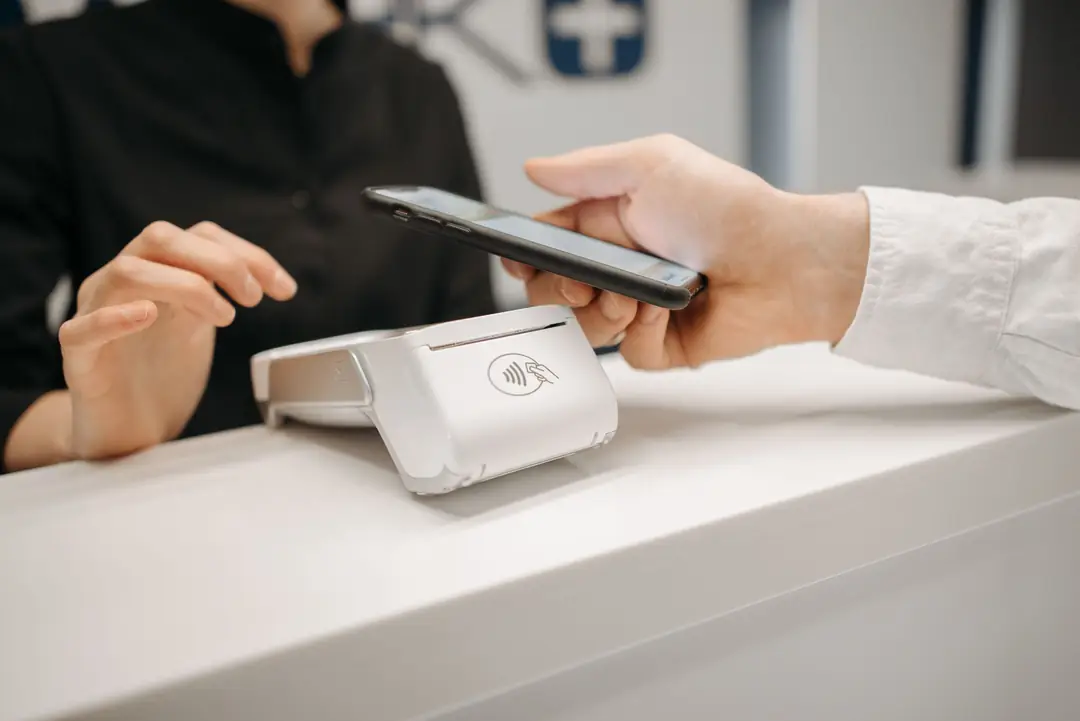
Whether it is a café with a card terminal, a hair salon that takes TWINT or an online shop running on Stripe, payment providers are now part of everyday life for many SMEs. In the books, however, they regularly cause discrepancies. The reason is simple: the customer pays the full price, but a smaller amount reaches your bank account, often bundled together for several days. With a clearing account and a clear routine, you can book these payments cleanly.
The core problem: sold gross, paid out net
Take an example. A café takes CHF 1,240.00 in one day for food and drinks, all paid through a card terminal. The payment provider deducts a fee, assumed here to be 1.3%, or CHF 16.12, and pays out CHF 1,223.88 two days later.
If you book only the bank credit as revenue, you make two mistakes:
- Revenue is understated by CHF 16.12.
- The fee never appears as an expense.
Both distort your income statement (profit and loss). On top of that, there is a VAT problem.
VAT: due on the full amount
VAT is calculated on the consideration actually received, in other words on what the customer pays. Art. 46 of the VAT Ordinance states explicitly that credit card commissions and similar charges are not reductions in consideration (Entgeltsminderungen). The payment provider's fee therefore does not reduce your taxable turnover.
For the café, this means VAT is due on CHF 1,240.00, not on CHF 1,223.88. At 8.1%, that is CHF 92.91, included in the gross amount. If you declare the net amount as revenue, you will consistently report too little VAT.
The solution: one clearing account per payment provider
A clearing account, also known as a transit account (Durchlaufkonto), holds the revenue until the money reaches your bank. Keep a separate account for each provider, for example "Clearing account TWINT", "Clearing account Stripe" and "Clearing account SumUp".
Entries in the example:
| Step | Debit | Credit | Amount CHF |
|---|---|---|---|
| 1. Daily takings from end-of-day cash report | Clearing account card payments | Revenue (with VAT code 8.1%) | 1,240.00 |
| 2. Bank credit | Bank | Clearing account card payments | 1,223.88 |
| 3. Fee as shown on provider statement | Payment transaction fees | Clearing account card payments | 16.12 |
After these three entries, the clearing account is back at zero. That is exactly the check: if a balance remains, a payout is missing, a fee has not been recorded or a sale has been booked twice.
TWINT, Stripe and SumUp: what to watch for with each
The logic is the same for every provider, but the details differ:
TWINT: depending on your contract, payments are transferred individually or in batches. What counts for your bookkeeping is the statement provided by the provider or your bank. It shows revenue, fees and payouts for each period.
Stripe: online shops usually receive batch payouts that combine many orders, refunds and fees. For your books, you therefore need the provider's payout report, which shows which transactions, refunds and fees make up each payout. Payments in foreign currencies add a conversion step. For VAT purposes, the rates set out in Art. 45 of the VAT Ordinance apply, not the provider's exchange rate.
SumUp and other card terminals: here, too, payouts are usually net. The terminal's daily report and the provider's payout summary together form your supporting document.
Keep these statements as accounting records. They are the basis for step 3 and, like all receipts, must be kept for ten years.
Fees and input tax
Whether you can deduct input tax on the fees depends on whether the provider charges Swiss VAT. The statement is what counts: if it shows no tax, there is no input tax to reclaim. With providers based abroad, there is also the question of reverse-charge tax (Bezugsteuer). It does not apply to services that are exempt from VAT under Art. 21 of the VAT Act (Art. 45a VAT Act). The best approach is to clarify once with your accountant (Treuhänder) how your provider's fees should be treated, and to record the outcome in your internal procedures.
Refunds and chargebacks
If your online shop refunds an order or a card payment is charged back, record it as a reduction in revenue, again through the clearing account:
| Transaction | Debit | Credit |
|---|---|---|
| Refund to customer | Revenue (reduction, with VAT code) | Clearing account |
| Any chargeback fee | Payment transaction fees | Clearing account |
This correctly reduces the VAT on the refund. What matters is that each refund can be traced back to an order.
End-of-day cash-up and reconciliation
To keep the figures right, you need a daily or at least weekly routine:
- End-of-day cash-up broken down by payment method: cash, card, TWINT, invoice.
- Book revenue by payment method to the relevant clearing account.
- Match bank credits to the clearing account.
- Book fees as shown on the statement.
- Check the balance: once all payouts have arrived, the clearing account should be at zero. At month-end, the only open amounts should be those paid out the following month.
Example of a monthly reconciliation
In October 2026, a hair salon takes a total of CHF 6,480.00 through TWINT. According to the provider's statement, CHF 6,389.30 was paid out and CHF 90.70 deducted in fees. By the end of the month, bank credits of CHF 6,102.15 have arrived, and the last payout follows on 2 November.
| Clearing account TWINT | CHF |
|---|---|
| October revenue (debit) | 6,480.00 |
| October bank credits (credit) | 6,102.15 |
| Fees shown on statement (credit) | 90.70 |
| Balance at 31 October | 287.15 |
The outstanding payout on 2 November is exactly CHF 287.15. The balance is explained, so it is not an error. If the amounts did not match, that would be the moment to investigate, while the figures are still fresh.
Common mistakes
- Net amount booked as revenue: revenue and VAT too low, fees invisible.
- Batch credit without a breakdown: without the provider's statement, you cannot tell which sales and fees it includes.
- One clearing account for everything: if you book TWINT, cards and your online shop to a single account, discrepancies become almost impossible to track down.
- Exchange differences booked as fees: with foreign currencies, exchange differences belong in financial income or financial expense, not in fees.
- Open balances ignored at year-end: a remaining balance on the clearing account at the year-end closing points to missing entries.
Automate where you can
The routine becomes much simpler if you import bank data via camt.053 and capture the payment providers' statements as receipts. In Buchsnap, you can set up rules for each payment provider, so the payout and fee appear as suggestions when you import and you only need to confirm them.
Last updated: October 2026. This article does not replace individual advice.
Frequently asked questions
Do I pay VAT on the gross amount or on the payout from TWINT, Stripe or SumUp?
On the gross amount, meaning what the customer paid. Under Art. 46 of the VAT Ordinance, credit card commissions and similar fees are not treated as a reduction in consideration.
What is a clearing account in accounting?
An auxiliary account that records the revenue from one payment method before the money reaches the bank. Once the payout and fees are booked, it is back at zero; any remaining balance points to an error.
Do I need a separate account for each payment provider?
It is recommended. Separate clearing accounts for TWINT, the card terminal and the online shop make discrepancies visible straight away and make it easier to reconcile against the providers' statements.
How do I book TWINT, Stripe or SumUp fees?
As an expense, for example to an account for payment transaction fees, with the contra entry on the clearing account. The basis is the provider's statement, which you keep as a supporting document.
Can I deduct input tax on payment provider fees in Switzerland?
Only if the provider charges Swiss VAT and shows it on the statement. With foreign providers, you also need to check reverse-charge tax, which does not apply to services exempt from VAT.
How do I book customer refunds from Stripe or TWINT?
As a reduction in revenue with the appropriate VAT code, with the contra entry on the clearing account. This also correctly reduces the VAT you owe.
Sources
- Fedlex: Mehrwertsteuerverordnung, Art. 45 und 46 MWSTV (VAT Ordinance, Arts 45 and 46)
- Fedlex: Mehrwertsteuergesetz, Art. 21, 24, 45 und 45a MWSTG (VAT Act, Arts 21, 24, 45 and 45a)
- Fedlex: Obligationenrecht, Art. 957a und 958f OR (Swiss Code of Obligations, Arts 957a and 958f)
- ESTV: MWST-Steuersätze (FTA overview of Swiss VAT rates)
- ESTV: Fremdwährungskurse MWST (FTA exchange rates for VAT)
- #TWINT
- #Stripe
- #SumUp
- #clearing account
- #payment fees
- #VAT
Are you an accountant?
Buchsnap is free for accounting firms. Your clients send receipts through the app, you do the bookkeeping.
Sign up free →


More articles
Accounting
Keeping business records in Switzerland: 10 years, GeBüV and digital archiving
Ten years of retention, but from when exactly? And can you throw away paper receipts once they are scanned? An overview of the CO, the GeBüV and VAT practice, with a checklist for your digital archive.
12 October 2026 · 6 min read

Accounting
Bookkeeping requirements in Switzerland: sole proprietorship, GmbH or AG?
From CHF 500,000 in revenue, sole proprietorships face full bookkeeping, while a GmbH or AG always does. What Art. 957 CO requires, what simplified bookkeeping allows and when you need an audit.
12 October 2026 · 6 min read

Accounting
Year-end closing for SMEs: a checklist from stocktake to general meeting
Year-end closing gets easier when you plan it in stages. This checklist takes you through reconciliations, accruals, depreciation and deadlines, with examples and the rules from the Code of Obligations.
12 October 2026 · 6 min read